
Stanford University
Cegelski Lab
Harnessing chemistry in nature and our imagination for a brighter future.
Discovering and Harnessing the Chemical Principles
that Organize Living Systems
Our laboratory uncovers the chemical principles that organize living systems. Across biology - from microbial communities to human disease - chemical and macromolecular composition, molecular interactions, and chemical modifications govern the assembly, function, and persistence of complex biological systems, yet many of these principles remain hidden from conventional approaches.
We develop innovative chemical, structural, and biological strategies to preserve and interrogate intact biological systems, revealing chemistry that cannot be observed by studying isolated components alone. Our work has uncovered previously unknown molecular structures, chemical modifications, and mechanisms of biological organization, including the discovery of phosphoethanolamine (pEtN) cellulose, a chemically modified form of cellulose that fundamentally changed our understanding of bacterial extracellular matrices.
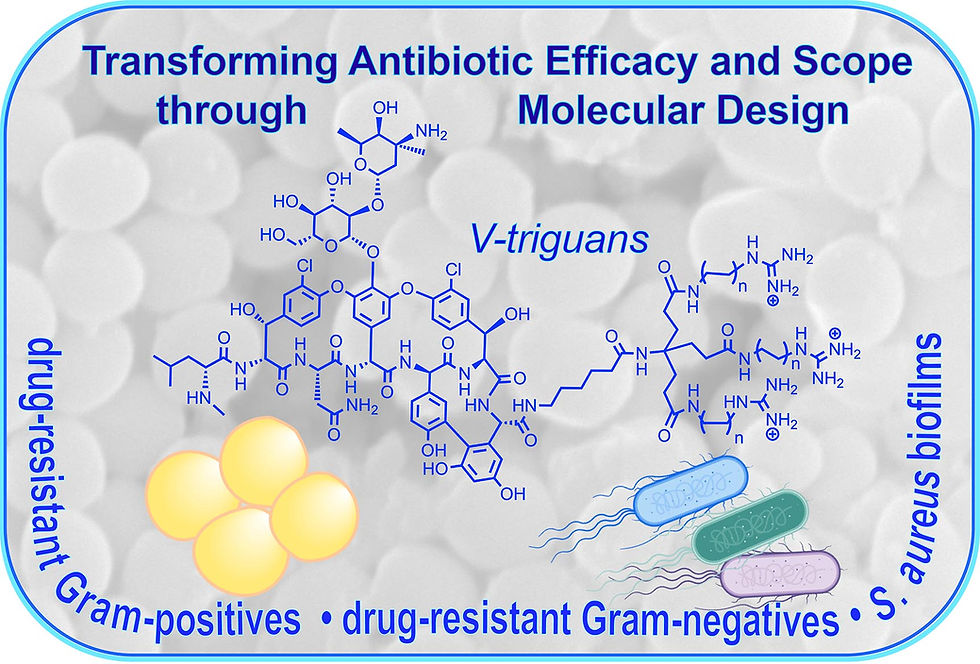
In parallel, we discover and engineer molecules that probe, disrupt, and control biological systems. A major focus is the development of new strategies to combat antibiotic resistance and persistent bacterial communities. Our laboratory has introduced first-in-class vancomycin conjugates with multiple modes of action, unusually broad-spectrum activity, and the ability to sterilize biofilms - properties not observed together in other vancomycin conjugates. We also develop anti-biofilm agents, molecular probes, imaging agents, and other chemical tools that both reveal new biology and provide starting points for addressing pressing challenges in human health and disease.
Together, our research spans fundamental chemical discovery and molecular invention: uncovering the chemistry that enables biological systems to assemble and persist, and using those insights to create new ways to interrogate and control them. This work opens opportunities to combat infectious disease, improve human health, preserve marine ecosystems, advance sustainable materials, and deepen our understanding of how chemistry organizes life.

Chemical Organization of Cell Envelopes and Biofilms
Bacteria colonize nearly every environment on Earth, from soils and oceans to plants, animals, and humans. Their success depends on chemically organized cell envelopes and extracellular biofilm matrices that enable attachment, persistence, and protection from environmental stresses, host defenses, and antibiotics. We uncover the chemistry and molecular interactions that govern the assembly of these remarkable biological architectures, revealing new principles of bacterial organization while inspiring innovative strategies to control infection and harness microbial systems for beneficial applications.


Chemical Innovation for Human Health
Drug-resistant bacterial infections demand fundamentally new therapeutic strategies. We design and discover first-in-class antibacterial molecules that overcome resistance, disrupt bacterial cell-envelope and biofilm biology, and exhibit new mechanisms of action. By integrating synthetic chemistry with mechanistic studies of intact biological systems, these molecules serve both as promising therapeutic candidates and as chemical probes that uncover previously hidden aspects of bacterial physiology, providing new opportunities for antibiotic discovery and biological insight.


Innovations in Solid-State NMR for Chemical Discovery
Many of biology's most important molecular interactions occur within complex, heterogeneous, and often insoluble systems that remain inaccessible to conventional analytical approaches. We develop and integrate solid-state NMR with complementary structural, chemical, and imaging methods to reveal chemistry within intact biological systems, from bacterial biofilms and cell walls to plant tissues, insect biomaterials, marine organisms, and synthetic polymers. Because every biological system presents unique chemical and structural challenges, we design new isotope-labeling strategies, pulse sequences, and experimental approaches tailored to each problem. These capabilities enable us to directly uncover molecular interactions, chemical modifications, and structural organization that would otherwise remain hidden.


Microbial Amyloids & Extracellular Organization
Microbial extracellular matrices are among nature's most sophisticated self-assembled biological materials. We investigate how functional amyloid fibers, chemically modified polysaccharides, and other extracellular polymers interact to construct organized biofilm architectures that enable bacterial persistence, communication, and adaptation. By uncovering the molecular interactions and chemical modifications that govern these assemblies, we reveal fundamental principles of extracellular organization with implications that extend beyond microbiology to human disease and sustainable biomaterials. In parallel, we discover small molecules that selectively perturb these interactions, providing powerful chemical probes and new opportunities for anti-biofilm and anti-virulence therapeutics.

